
Family is one of the most universal themes in human life, and language reflects this beautifully. Idioms, which are colorful expressions that carry a figurative meaning different from their literal words, help make conversations more engaging.
They are widely used in English to describe everyday experiences, emotions, and relationships.
When it comes to family, idioms are especially powerful because they express love, connection, struggles, and traditions that every culture understands.
Learning idioms for family not only enriches vocabulary but also allows learners to communicate feelings about home, relatives, and relationships in a natural and expressive way.
Whether you are writing, speaking, or simply trying to understand native English, these idioms give you insight into how people value family bonds in daily life.
Did You Know?
Many idioms related to family have roots in ancient traditions and farming communities. For example, the phrase “the apple doesn’t fall far from the tree” comes from observing real apple trees, symbolizing that children often resemble their parents. This shows how everyday life shaped the language we still use today!
Idioms About Parents and Children
The apple doesn’t fall far from the tree
Meaning: Children often resemble their parents in looks or behavior.
Example: “He’s a great musician, just like his father. The apple doesn’t fall far from the tree.”
Alternative: “Like father, like son.”
Note: Common in casual speech to highlight similarities.
Like father, like son
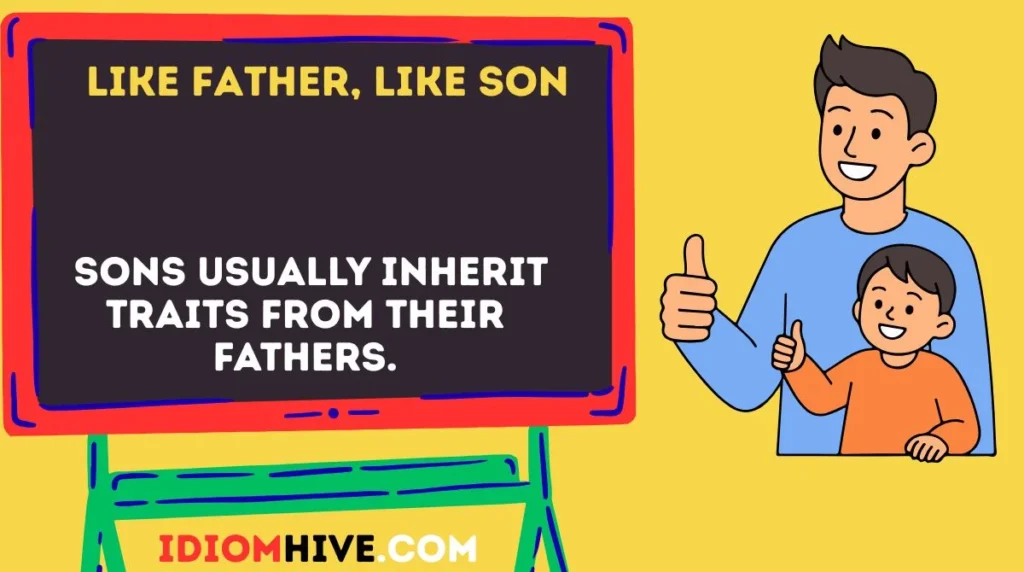
Meaning: Sons usually inherit traits from their fathers.
Example: “John is as stubborn as his dad. Like father, like son.”
Alternative: “Cut from the same cloth.”
Note: Informal, often used in family conversations.
Chip off the old block
Meaning: Someone who is very similar to one of their parents.
Example: “She’s clever and confident—a real chip off the old block.”
Alternative: “Spitting image.”
Note: Often used affectionately in daily life.
Spitting image
Meaning: A person who looks exactly like someone else, especially a parent.
Example: “She’s the spitting image of her mother.”
Alternative: “Carbon copy.”
Note: Focuses on appearance rather than personality.
Mama’s boy
Meaning: A man who is overly attached to his mother.
Example: “He still calls his mom for every decision—what a mama’s boy!”
Alternative: “Attached to his mother’s apron strings.”
Note: Informal, sometimes slightly teasing.
Daddy’s girl
Meaning: A girl who is very close to her father.
Example: “She’s always been a daddy’s girl, spoiled with love.”
Alternative: “Father’s pet.”
Note: Informal, often affectionate.
Skeleton in the closet
Meaning: A hidden family secret.
Example: “Every family has a skeleton in the closet.”
Alternative: “Hidden truth.”
Note: Often used in formal or casual discussions about secrets.
Idioms About Siblings and Relatives
Blood is thicker than water
Meaning: Family bonds are stronger than other relationships.
Example: “I argued with my brother, but I’ll forgive him—blood is thicker than water.”
Alternative: “Family comes first.”
Note: Common in everyday speech about loyalty.
Black sheep of the family
Meaning: The family member who is considered different or a troublemaker.
Example: “He never studied and always got into trouble—the black sheep of the family.”
Alternative: “Outcast.”
Note: Informal, often in negative context.
Flesh and blood
Meaning: Your family members, especially close relatives.
Example: “How can you ignore your own flesh and blood?”
Alternative: “Your own kin.”
Note: Often used in emotional contexts.
Big brother
Meaning: An older brother; also used for controlling authority (from Orwell).
Example: “He’s always protecting me like a big brother.”
Alternative: “Guardian.”
Note: Daily use in family or political references.
Run in the family
Meaning: A trait or characteristic shared by many family members.
Example: “Artistic talent runs in the family.”
Alternative: “In the blood.”
Note: Common in casual speech.
Family ties
Meaning: The bond between family members.
Example: “Strong family ties kept them close despite living apart.”
Alternative: “Family bond.”
Note: Neutral, used in formal and informal settings.
Born with a silver spoon in one’s mouth
Meaning: Born into a wealthy family.
Example: “He never had to work hard—born with a silver spoon in his mouth.”
Alternative: “Privileged birth.”
Note: Often used critically or descriptively.
Your own flesh and blood
Meaning: Refers to someone in your immediate family.
Example: “She’s your own flesh and blood—you can’t abandon her.”
Alternative: “Blood relative.”
Note: Emotional, often persuasive.
Idioms About Marriage and Household
Tie the knot
Meaning: To get married.
Example: “They’re planning to tie the knot next summer.”
Alternative: “Get hitched.”
Note: Informal, very common.
Ball and chain
Meaning: A humorous way of referring to a spouse (usually wife).
Example: “I can’t go out tonight—the ball and chain won’t allow it.”
Alternative: “Other half.”
Note: Informal, often joking.
Happy ever after
Meaning: An ideal perfect married life.
Example: “They’re living their happy ever after in the countryside.”
Alternative: “Fairy-tale ending.”
Note: Used in stories or casual talk.
Wear the pants in the family
Meaning: The person who has the control in the household.
Example: “Everyone knows she wears the pants in the family.”
Alternative: “Call the shots.”
Note: Informal, humorous or critical.
Mother hen
Meaning: Someone who is very protective and caring, like a mother.
Example: “She’s always fussing over us, a real mother hen.”
Alternative: “Overprotective.”
Note: Informal, affectionate.
Father figure
Meaning: Someone who acts as a guiding or protective father.
Example: “My coach was a father figure to me.”
Alternative: “Mentor.”
Note: Used formally and informally.
Idioms About General Family Life
Family man
Meaning: A man devoted to his family.
Example: “He always puts his children first—he’s a true family man.”
Alternative: “Devoted father.”
Note: Positive, common in daily use.
Nuclear family
Meaning: A family unit with parents and children only.
Example: “In cities, people often live in nuclear families.”
Alternative: “Immediate family.”
Note: Formal, common in sociology.
Extended family

Meaning: Family that includes grandparents, aunts, uncles, cousins, etc.
Example: “We celebrated the holiday with our extended family.”
Alternative: “Relatives.”
Note: Neutral, formal or casual.
Home is where the heart is
Meaning: Wherever your loved ones are feels like home.
Example: “Even abroad, she feels happy with her family—home is where the heart is.”
Alternative: “Family makes a home.”
Note: Inspirational and poetic.
East or west, home is best
Meaning: No matter where you go, home is the most comfortable place.
Example: “After traveling, he realized east or west, home is best.”
Alternative: “There’s no place like home.”
Note: Common in sayings and quotes.
Family affair
Meaning: Something involving family members only.
Example: “The business is a family affair.”
Alternative: “Family business.”
Note: Formal and casual use.
Family circle
Meaning: Close relatives forming a supportive group.
Example: “She was welcomed warmly into the family circle.”
Alternative: “Family unit.”
Note: Emotional and positive.
How to Use These Idioms in Daily Life
- Speaking: Use idioms naturally in conversations to sound fluent. For example, instead of saying “He looks like his father,” you can say, “He’s a chip off the old block.”
- Writing: Idioms enrich stories, essays, and even social media captions. For example: “After ten years, they finally tied the knot.”
- Professional usage: Use carefully in presentations or reports to make communication vivid. Example: “Strong family ties play a role in employee stability.”
Common Mistakes Learners Make With Idioms
- Literal usage:
❌ Wrong: “She tied the knot on her shoes.”
✅ Correct: “They tied the knot last year.” - Mixing idioms:
❌ Wrong: “He’s the black apple of the family.”
✅ Correct: “He’s the black sheep of the family.” - Overuse in formal writing:
❌ Wrong: “The company is the apple that doesn’t fall far from the tree.”
✅ Correct: “The company reflects its parent organization’s values.”
Frequently Asked Questions
1. What are idioms for family?
They are expressions in English that describe family relationships, behaviors, or traditions in a figurative way.
2. Why should I learn family idioms?
They make conversations sound more natural, expressive, and connected to culture.
3. Are family idioms formal or informal?
Most are informal and used in daily life, but some (like “extended family”) are also common in formal contexts.
4. Can I use idioms in professional writing?
Yes, but sparingly. Use them when they add clarity or style, not when a straightforward word works better.
5. What is the most popular family idiom?
“Blood is thicker than water” is among the most common idioms about family.
Conclusion
Family idioms add warmth, humor, and cultural flavor to English. They help you describe relationships in a colorful and memorable way, whether you’re talking about parents, siblings, marriage, or daily life.
From saying someone is a chip off the old block to reminding ourselves that home is where the heart is, these expressions carry emotions everyone can relate to.
By learning and using them, you’ll not only improve your English but also connect more deeply with the universal theme of family.
So, the next time you talk about your loved ones, try sprinkling in a few idioms—you’ll sound more natural and expressive!